
Latest
The Sustainable Development Goals in The Gambia
The Sustainable Development Goals are a global call to action to end poverty, protect the earth's environment and climate, and ensure that people everywhere can enjoy peace and prosperity. These are the goals the UN is working on in The Gambia.
The Resident Coordinator leads the UN Country Team (UNCT) and ensures that the UN agencies support the national development priorities through three UNDAF outcome areas.
These are: (i) Governance, Economic Management and Human Rights supporting initiatives aimed at strengthening national institutions responsible for economic and financial management and oversee reforms to guarantee people their human rights; (ii) Human capital development supporting access to education and health care services, improving equitable quality and access to water, sanitation and hygiene, social protection and gender and youth empowerment; and (iii) Sustainable agriculture, natural resources, environment and climate change management covering agricultural production and productivity, food and nutrition security, environmental management, mainstream climate change in environment and disaster risk management.
The UN Country Team coordinate their work through joint Work Plans.
Publication
30 March 2025
UN Gambia Annual Report 2024: Building Pathways To Sustainable Development
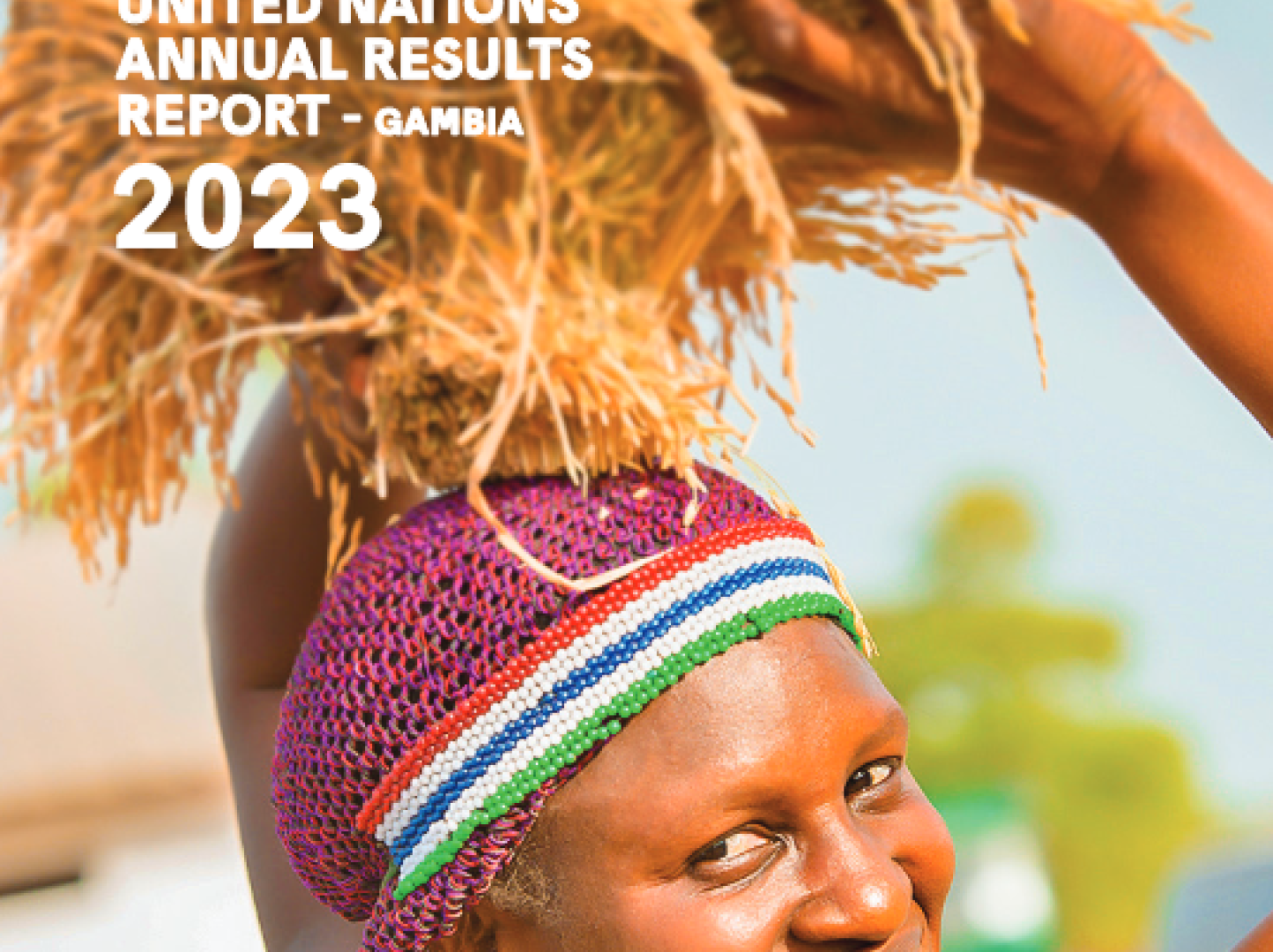
On behalf of the UN Country Team (UNCT) in The Gambia, we are pleased to present the 2024 One UN Annual Results Report. The report details how the UN collaborated with the Gambian government and development partners, working together to fulfil the accelerate SDG progress in The Gambia.
1 of 2

Take Action
19 December 2025
Let's Take Action Towards the Sustainable Development Goals
5 years for People. Planet. Impact. We must do more to accelerate progress on the sustainable development goals.
1 of 2

Story
11 May 2026
How Marie Found Her Market
In the quiet farming community of Njawara, Marie Jobe spends most of her mornings tending to her small plot at the Njawara Women's Community Garden. Since 2021, she has been growing tomatoes, green pepper, cauliflower and other vegetables, produce that supports both herself and her family. The garden, shared with dozens of other women from the community, has become both a source of income and a space of collective effort, where women cultivate side by side and share the daily work of feeding their households.Like many women producers across rural Gambia, Marie worked hard but faced challenges that limited her income and growth. Long hours in the field, the rising cost of inputs, and unpredictable weather were part of the daily reality. Yet despite her dedication, the returns from her labour rarely reflected the effort she put in.Her biggest struggle was access to bigger and better markets. "We only depended on the local market," she recalled. "The prices there are not good for us. We always sell at a low price." With limited buyers and an abundance of similar produce from neighbouring growers, prices often fell below what was needed to sustain her work. At times, vegetables she had carefully tended for weeks would spoil before they could be sold.Marie also lacked information on quality control, basic food safety and production planning, knowledge that would help her grow the right crops at the right time to meet demand. Without access to such information, planting decisions were often guided by habit rather than market signals, leaving small producers vulnerable to losses.To address these gaps, efforts are underway to connect small producers like Marie with hotels, restaurants and other businesses in the tourism sector, a market segment that offers more stable demand and better prices for quality produce. The initiative aims to strengthen the link between rural women farmers and the wider Gambian economy, while improving food safety standards along the value chain.Marie was among the farmers trained in production calendars, market access and food safety. The training brought together women from across the area to learn practical skills they could apply directly to their plots and their businesses.The training gave her a new perspective. "We learned basic food safety in production and quality control," she said. "I also learned the production cycle, when to plant so that you can sell at a good price." For Marie, the lessons have changed not only how she farms, but how she sees her role as a producer, one whose work has value beyond the local market, and whose skills can connect her to new opportunities.
1 of 5

Story
27 March 2026
How One Young Farmer Is Feeding Minds and Healing Land in The Gambia with the HGSF New Procurement Model
In a small community called Mamud-Fana, in Central River Region-South (CRR-S) of The Gambia, a young woman named Satou Ata Ceesay is changing the way her community thinks about food, farming, and the future. Her story is part of a growing movement powered by the United Nation World Food Programme’s (UN WFP) Home-Grown School Feeding (HGSF) New Procurement Model a model that’s not just feeding children but transforming lives from the ground up. Satou is a farmer, aggregator, an employer, and a steward of the land. On her modest plot, she grows groundnut and vegetables (Okra, Pepper, Orange Flesh Sweet Potato, Pumkin, etc.) using organic compost and water-saving techniques. But her impact stretches far beyond the furrows of her fields. Through the HGSF model, Satou supplies food directly to nearby schools, ensuring that children eat fresh, nutritious meals grown in their own communities.“We’re not just feeding children,” Satou says, brushing soil from her hands. “We’re protecting the land they’ll inherit.” She is not alone. Across The Gambia, over 1,000 smallholder farmers like Satou have become key players in the school feeding programme. Since the launch of the new procurement model in 2023, more than 1,395 metric tons of food have been sourced locally, injecting over USD 1.7 million into the rural economy. But Satou’s story adds more value to those numbers, she employs four youth from her village, teaching them sustainable farming practices and giving them a reason to stay rooted in their land. Her groundnuts do not travel far, it’s harvested, processed, and delivered within a few kilometers of the schools it feeds. While Satou’s farm represents grassroots change, Maruo Farms shows how local enterprises can scale that impact. Located just kilometers from the schools it serves, Maruo harvests, mills, and packages fortified rice that replaces imported alternatives. Each year, Maruo supplies over 500 metric tons of rice to 254 schools, reducing transport emissions and post-harvest losses. Their partnership with local farmers has boosted confidence and cooperation, proving that climate-smart agriculture can be both sustainable and scalable.This synergy between individual farmers and local enterprises is the backbone of the HGSF model.In Janjanburreh, Mothers’ Clubs are taking charge of school menus and inspecting meals daily at the Methodist Lower Basic School. Anta Jobarteh, President and the club representative, who have benefited from the school feeding programme during her school days, reflects on the change: “Before, we didn’t know where the food came from. Now, we know the farmers. We know the land. And we teach our children to respect both.”This sense of ownership is echoed in Dankunku, where cooperative leader Fatou Fatty, uses a tricycle provided by WFP to deliver fresh produce, reducing spoilage and delivering on time. “The tricycle is not just a vehicle,” she says. “It’s a lifeline for our harvests.”The decentralized procurement system anchored by Cluster Procurement Committees ensures that farmers provide what is needed, and when it is needed. The WFP HGSF new procurement model is built on transparency, accountability, and regenerative agriculture.For Satou, it’s also a model of hope, her work is restoring soil health, creating jobs, and feeding minds. It’s proof that when communities are involved not just consulted, real change takes root.As climate shocks continue to threaten food systems across West Africa, Satou’s story offers a blueprint for resilience. It begins with a handful of compost, a plate of nutritious food, a smiling child and a young woman who believes that the future grows best when it’s grown together.
1 of 5

Story
23 March 2026
Small Packet - Big Change
In Cha Kunda in the Central River Region, Jonfolo Manneh watched her son Ebrima fade. What had begun as a loss of appetite became something far more alarming, a small body growing weaker by the day, too tired to eat, too fragile to play. Like many mothers in communities where the signs of severe acute malnutrition can creep in gradually and without warning, Jonfolo did not immediately have a name for what was happening to her child. She only knew that the boy who had once filled their home with laughter was disappearing before her eyes.Then, a community health worker came to their door.As part of a nationwide effort to strengthen nutrition services for children under five, community health workers trained in early detection visited households in Cha Kunda, identifying children at risk and connecting families to treatment before conditions became life-threatening. It was during one of these visits that Ebrima's condition was first properly recognised, not by a doctor in a distant hospital, but by a trained health worker who knew the community, knew the signs and knew what to do next. For Jonfolo, that knock on the door marked the moment everything began to change."I had been watching him get weaker and I did not know where to turn. When the health worker came and explained what was happening to my son, I felt both fear and relief at the same time fear because I finally understood how serious it was, and relief because someone was there to help us," said Jonfolo Manneh, mother of Ebrima. Ebrima was enrolled in a treatment programme that included the provision of Ready-to-Use Therapeutic Food, a specially formulated, nutrient-dense paste provided by the UN and designed to reverse the devastating effects of severe acute malnutrition and restore a child's strength from within. Week by week, the change that Jonfolo had feared might never come began to reveal itself in Ebrima's appetite, in his energy, in the light returning to his eyes. "My son was so weak he could not eat. When the health worker came and gave us the therapeutic food, I saw him change week by week. Today he runs and plays like any other child. I did not think that was possible," she said.Today, Ebrima is a different child. He runs through the compound, chases friends and eats with an appetite that once seemed unimaginable. In 2025, 3,584 children received treatment for severe acute malnutrition, achieving an 81.4 percent cure rate that exceeds international standards. Behind every percentage point is a child like Ebrima and a mother like Jonfolo, a family given back what malnutrition had threatened to take away.In Cha Kunda, the health worker still visits. The community still screens. And Ebrima still runs.
1 of 5

Story
23 March 2026
A New Chapter for Civil Society in Basse
For years, the organizations working to make life better for communities in the Upper River Region (URR) had one thing in common: they were doing it alone.Civil society organizations (CSOs) in Basse shared the same worries, served the same people, and fought for many of the same causes. But they rarely shared a room. Each organization worked in its own corner, trying to stretch limited resources across big problems of gender equality, peacebuilding, and community development, without a common space to plan, connect, or coordinate.The distance was not just physical. It was the kind of isolation that quietly weakens even the most dedicated organizations. That changed in 2025.The opening of the CSO House in Basse marked a turning point. More than just a building, it was built to be a home, a dedicated hub where organizations across the URR could finally come together under one roof to coordinate their advocacy, engage their communities, and take collective action on the issues that matter most.For the first time, groups working on gender equality could sit across the table from those focused on peacebuilding. Organizations tackling community development could align their plans with those of others working toward the same goals. The walls that once separated them, logistical, financial, and geographical, began to come down.For The Association of Non-Governmental Organizations (TANGO), the meaning of the CSO House runs deeper than bricks and mortar."For CSOs operating in the Upper River Region, distance and isolation have always been barriers to effective coordination. This space changes that," said Ndey Bakurin, Executive Director of TANGO. "It gives organizations a safe and dedicated home to come together, align their efforts, and advance their mandates with greater impact."She added simply: "When CSOs are connected, the communities they serve are stronger for it."It is a statement that reflects what many in Basse already know from experience, that meaningful change rarely comes from one organization working alone. It comes when people with shared values and shared goals finally find each other.The CSO House is that place. And for the communities of the Upper River Region, its doors being open means their voices can now be heard louder, clearer, and together.
1 of 5

Story
19 March 2026
How Bantanjang is Bringing its Mangroves Back to Life
Famara Tamba remembers when the mangroves lined the waterways of Bantanjang like sentinels dense, green and alive with the sounds of birds and the movement of fish beneath their tangled roots. Then, slowly, they began to disappear.Climate change came to Foni not with a single dramatic event, but with a creeping shift rising salinity, erratic rainfall, and advancing tides that gnawed at the coastline season by season. As the mangroves declined, so too did the fish. The protective buffer that had shielded the community from flooding weakened. What had once been taken for granted was suddenly, painfully, absent.Today, Famara stands at the edge of a restored wetland where young mangrove seedlings reach upward from the mudflats small, determined, and full of promise. Thanks to a UN intervention through the PROREFISH Gambia project, Bantanjang is in the midst of something remarkable: it is growing its future back, one root at a time.To understand what the loss of mangroves meant for Bantanjang, one must first understand what mangroves are. They are among the most ecologically valuable ecosystems on the planet. A single hectare of healthy mangrove forest can store up to five times more carbon than a tropical rainforest making them powerful, natural allies in the fight against climate change. Their dense root systems stabilise coastlines, prevent erosion, and act as a natural barrier against flooding and storm surges. Research has shown that communities protected by mangroves experience significantly fewer climate-related casualties than those without this natural shield.Mangroves are also the ocean's nurseries. Countless species of fish, crab and oyster depend on them for breeding and shelter during their juvenile stages meaning the health of mangrove forests is directly tied to the health of fisheries, and therefore to the food security and livelihoods of communities like Bantanjang. In The Gambia, where fishing is central to daily life and nutrition, their decline has been felt in every household."It has helped us a lot. The plantation of the mangroves has helped our community so much especially the children, who will grow up to be the caretakers of this community." Famara Tamba,The PROREFISH Gambia project the Climate Resilient Fishery Initiative for Livelihood Improvement in The Gambia is a six-year, USD 25 million initiative that began over two years ago, financed by the Green Climate Fund (GCF). It is the first GCF-funded project globally to place fisheries at its centre, reflecting the unique vulnerability of coastal and riverine communities like those in Foni.In Bantanjang and communities across The Gambia's West Coast and Lower River Regions, the UN brought training, tools, and technical expertise. In Bantanjang, community members were trained in assisted natural regeneration, a careful, science-guided approach to selecting habitats, planting salt-tolerant species, and monitoring the health of restored areas over time."This training has opened our eyes to the importance of mangroves. We now understand how they protect us from floods and provide us with food. We are eager to be part of this effort to regenerate our mangroves." Famara Tamba, BantanjangOver 11,000 Gambian households are expected to benefit directly from the PROREFISH initiative, with more than 46,000 households, nearly one-sixth of the country's population benefiting indirectly. In communities like Bantanjang, that means more fish on tables, stronger coastlines, and children growing up knowing how to care for the environment that sustains them.For Famara, that last point matters most. The mangroves he is helping to restore are not just for today's generation. They are a legacy, patient, growing, and green for the children who will one day walk these same wetlands and find them alive."We used to take the mangroves for granted. But now we see their value. We are learning how to protect them and ensure they are here for our children and grandchildren."
1 of 5

Press Release
15 June 2026
Peacebuilding Week in The Gambia: 22-26 June 2026
From 22 to 26 June 2026, the United Nations, in partnership with the Government of The Gambia, civil society organizations, youth networks, and development partners, will commemorate the inaugural Global Peacebuilding Week in The Gambia. The week-long celebration will highlight the country's progress in advancing peace, social cohesion, democratic governance, and transitional justice, while recognizing the collective efforts that have contributed to these achievements.The Peacebuilding Week is anchored in the 2025 United Nations General Assembly and Security Council resolutions on peacebuilding and sustaining peace, reflecting a renewed global commitment to prevention, national ownership, and inclusive participation. The celebration provides an opportunity to showcase how these commitments are being translated into tangible results in The Gambia.The event comes at an important moment in the country's development journey, as The Gambia continues to advance key reforms and implement recommendations arising from its transitional justice process. It will serve as a platform to reflect on progress achieved, strengthen partnerships and promote inclusive approaches to sustaining peace and development.Throughout the week, Government institutions, civil society organizations, youth groups, media practitioners, and other stakeholders will come together through a series of dialogues, public engagements, and community events. These activities will celebrate shared achievements and reaffirm the collective responsibility of all stakeholders in building a peaceful, inclusive, and resilient future.As part of the celebrations, the Office of the Resident Coordinator will host a premiere screening of the documentary “Road to Kaira”, inspired by the Peacebuilding Impact Spotlight Report “Never Again in Practice”, which highlights the impact of peacebuilding efforts and the resilience of communities across The Gambia.The Peacebuilding Week represents more than a celebration of past achievements. It is an opportunity to renew the national commitment to sustaining peace and ensure that the voices of all Gambians, particularly women and young people, continue to shape the country's future. Through collective action and inclusive dialogue, The Gambia continues to demonstrate that peace is not only the absence of conflict, but a continuous process of building trust, strengthening institutions, and creating opportunities for all.
1 of 5
Press Release
06 February 2026
No Excuse, No Exception: Ending Female Genital Mutilation in The Gambia
As we observe the International Day of Zero Tolerance for Female Genital Mutilation, we are reminded of our shared responsibility to protect the life, health, dignity, and rights of every girl and woman in The Gambia.Female genital mutilation (FGM) remains a serious concern. Despite the important progress made through the Women’s Amendment Act of 2015, this harmful practice continues to affect too many families and communities. For the girls who experience it, and for the women who live with its consequences, FGM brings lasting physical and psychological harm. This reality calls for renewed and sustained collective action.According to 2019-2020 DHS more than three quarters of Gambian women aged 15 to 49 have undergone FGM. Behind these figures are individuals whose lives have been shaped by pain, health complications, distress and trauma which unfortunately, is still present in our communities today. In 2026 alone, 21,198 girls are at risk of FGM, with the number accumulating to 150,415 by 2030. Not long ago, in 2025, two babies have tragically died as a consequence of FGM. These are our daughters, sisters, neighbors, and friends. This is not just numbers nor does it show an abstract issue. It actually represents the lives of women and girls we have made promises to protect, empower and to live fulfilled lives. Research has confirmed there is absolutely no medical or any other kind of benefit, associated with FGM. Instead, it carries significant risks, including severe bleeding, infection, complications during childbirth, long-term emotional distress and even death. Women and girls in The Gambia and beyond have guaranteed rights from global, regional and national laws to bodily autonomy, safety, and the opportunity to reach her full potential.As we battle with significant threats and challenges to registered gains in protecting women and girls, it is of paramount importance to recognize the highly important roles played by key stakeholders including traditional leaders, civil society organizations, religious authorities, health workers, parents and young people who have put in concerted efforts working toward abandonment of FGM in The Gambia. Their courage and commitment commend strong recognition and require our continued support.Culture is dynamic. Across human history, societies have evolved by letting go or banning nefarious practices that do not serve the wellbeing of their people. Protecting girls from harm is fully compatible with Gambian values of care, dignity, and community solidarity.The Government of The Gambia demonstrated its leadership in 2015 by enacting legislation to prohibit and penalize FGM. Moving forward, continued and concerted efforts are needed to strengthen implementation, expand awareness, support survivors, and ensure that communities are fully engaged in prevention and shifting social norms on harmful practices. Laws are the foundation but are most effective when they are accompanied by education, dialogue, and locally driven solutions. In addition, the effectiveness of the law is mostly felt, when it is fully applied and FGM perpetrators brought to justice . Equally, men are our important allies and have an important role to play. Fathers, brothers, husbands, uncles and community leaders can help create environments where girls are protected, respected, and where families feel supported and empowered to say ‘no’ to FGM. Communities also play a central role. Mothers who decide not to subject their daughters to FGM should be empowered, encouraged and respected. Particularly grandmothers have a role to play in the fight against FGM as they are an important pillar of the circle of trust. Survivors who share their experiences should be met with compassion and care. Young girls who are at risk should be supported to build their agencies and bodily autonomy, comprehensive health services, psychosocial support, and safe spaces are essential components of healing and ending FGM.Furthermore, education remains one of our strongest tools. Girls who stay in school, understand their rights, and have access to economic opportunities are better equipped to make informed choices for themselves and for future generations. Investing in girls is investing in the nation’s sustainable development. They, and only then, have the rights to their own body. Their bodies, theirs rights!The United Nations (UN) in The Gambia stands ready to continue supporting the ongoing national efforts. Together with the Government, civil society organizations, religious leaders, and communities. The UN works to strengthen prevention, strengthen health systems, consolidate access to quality and inclusive education, improve survivor services, and amplify positive voices advocating for change.Ultimately, sustainable progress must be driven from within. Ending FGM requires collective ownership and shared commitment. It requires open dialogue, mutual respect, rule of law, access to justice, democracy and a focus on the wellbeing of women and girlsI strongly believe in a Gambia where every girl grows up healthy and empowered, where her body is respected, and where her future is shaped by opportunity rather than harm. This vision is achievable. The girls of the Gambia must be able to learn, lead, decide and thrive.On this International Day of Zero Tolerance for Female Genital Mutilation, I invite everyone to continue this important journey together. Let us talk openly, support one another, uphold the law, and protect the most vulnerable among us.Female genital mutilation is a violence against women and girls. It is a crime and a grave violation of human rights that has scarred generations of Gambian girls and women, and it must end. Gambian faith and values do not promote harm, and we need to uphold that.Zero tolerance is not about blame. It is about care. It is about responsibility. It is about ensuring that every girl can grow up safe, confident, empowered, and free.The choices we make today will define the future of Gambian girls. Let us choose protection, dignity, and hope.
1 of 5
Press Release
04 February 2026
UNDP and Africell offer better digital connectivity to young innovators in Sierra Leone and The Gambia
The United Nations Development Programme (UNDP) and Africell are teaming up to provide better digital connectivity to UNDP’s timbuktoo University Innovation Pods (UniPods) in Sierra Leone and The Gambia. The partnership will see Africell providing essential digital connectivity services to the UniPods, including 4G MiFi devices, high‑speed internet, and Internet of Things (IoT) devices. These contributions will enable young innovators working in the Unipods to develop, test, and scale solutions to local and global development challenges. Ziad Dalloul, Africell Group CEO and President of the Africell Impact Foundation, says: “This collaboration plays to everyone’s strengths by combining Africell’s connectivity expertise with UNDP’s innovation network. By equipping the UniPods in Sierra Leone and The Gambia with Africell’s signature internet services, we are investing in young Africans and helping to turn raw talent into successful enterprise”. Beyond connectivity, UNDP and Africell will collaborate on innovation and accelerator programmes designed to increase participation in the UniPods and deepen their long-term social impact. For example: these programmes will leverage robotics, entrepreneurship and digital skills courses that the Africell Impact Foundation is already delivering through its own network of learning centres in West Africa. The agreement underscores UNDP’s commitment to expanding Africa’s home-grown innovation ecosystem under the timbuktoo initiative. “Digital inclusion is key to Africa’s innovation future. This partnership expands digital access and gives young innovators the connectivity they need to turn ideas into impactful solutions. When we invest in young people’s talents and remove barriers to opportunity, we accelerate Africa’s path to competitiveness, and inclusive growth”, explains Ahunna Eziakonwa, Assistant UN Secretary General and Director of UNDP Regional Bureau for Africa. UNDP’s UniPods are high‑tech maker and innovation spaces in public universities that equip young people with the tools and skills to turn ideas into market‑ready solutions. UniPods fall within UNDP’s broader timbuktoo initiative, which is a series of programmes designed to boost investment in African founders and startups – including, in addition to UniPods, the timbuktoo Policy Labs and several thematic industry ‘hubs’ in major African cities. ENDS About AfricellAfricell is a leading African mobile network operator providing mobile and digital services in Angola, Democratic Republic of Congo, The Gambia and Sierra Leone. Through the Africell Impact Foundation, Africell supports community development, digital learning, arts, and youth empowerment initiatives aimed at building stronger and more connected societies. Learn more at: https://www.africell.com About UNDPUNDP is the leading United Nations agency fighting to end the injustice of poverty, inequality, and climate change. Working with our broad network of experts and partners in 170 countries, we help nations to build integrated, lasting solutions for people and planet. Learn more at undp.org/ http://www.undp.org/africa or follow @UNDP and @UNDPAfrica. For all media queries:Sam Williams, Group Communications Director, Africell, media@africell.comPraise Nutakor, Partnerships and Communications Specialist, UNDP Africa, New York, praise.nutakor@undp.org
1 of 5
Press Release
09 January 2026
Strengthening Agricultural Data Collection Through Improved Operational Mobility in The Gambia
● UNOPS officially hands over 85 motorcycles and safety equipment to the Gambia
Bureau of Statistics under the World Bank-funded HISWACA programme
● The delivered equipment is aimed at enhancing GBOS operational mobility to collect
high-quality harmonized data across the country, in preparation for the 2026
National Agricultural Sample Census.
Banjul, Gambia.— UNOPS officially handed over 85 motorcycles and related safety equipment to the Gambia Bureau of Statistics (GBOS), thereby enhancing the institution’s capacity to gather timely and high-quality data across the country.
The handover marks a key milestone under the World Bank-funded regional statistics harmonization and improvement programme, HISWACA, designed to improve country statistical performance, regional harmonization, data access and use, and to enhance modernization of the statistical system across West Africa.
During the ceremony held at the GBOS premises, UNOPS delivered 85 motorcycles, along with associated safety equipment, ensuring that enumerators and field staff can execute their duties safely and effectively. This support will also encompass the procurement and delivery of two SUVs, further enhancing GBOS's logistical capabilities and operational mobility, particularly in hard-to-reach areas.
The newly delivered motorcycles and equipment are essential for supporting the GBOS’s preparations for the upcoming Agricultural Census scheduled for 2026, enabling field teams to reach communities nationwide. The new National Agricultural Sample Census will gather crucial information on farming practices, livestock and livelihoods, serving as a
reliable basis for agricultural planning and policy and to support food security and poverty alleviation strategies.
ENDS
Notes to the editors: Press contact details:
Souhaila Merzougui, Communications Senior Officer, UNOPS West Africa Multi Country Office | souhailam@unops.org
About UNOPS
UNOPS offers practical solutions across peace and security, humanitarian and development operations. We help the United Nations, governments and other partners to manage projects, and deliver sustainable infrastructure and procurement across the world.
Read more: www.unops.org.
About the World Bank
The World Bank Group is an international development organization with 189 member countries. It works to reduce poverty and boost shared prosperity on a livable planet by providing policy advice, technical expertise, and financing to the governments of low- and middle-income countries.
Bureau of Statistics under the World Bank-funded HISWACA programme
● The delivered equipment is aimed at enhancing GBOS operational mobility to collect
high-quality harmonized data across the country, in preparation for the 2026
National Agricultural Sample Census.
Banjul, Gambia.— UNOPS officially handed over 85 motorcycles and related safety equipment to the Gambia Bureau of Statistics (GBOS), thereby enhancing the institution’s capacity to gather timely and high-quality data across the country.
The handover marks a key milestone under the World Bank-funded regional statistics harmonization and improvement programme, HISWACA, designed to improve country statistical performance, regional harmonization, data access and use, and to enhance modernization of the statistical system across West Africa.
During the ceremony held at the GBOS premises, UNOPS delivered 85 motorcycles, along with associated safety equipment, ensuring that enumerators and field staff can execute their duties safely and effectively. This support will also encompass the procurement and delivery of two SUVs, further enhancing GBOS's logistical capabilities and operational mobility, particularly in hard-to-reach areas.
The newly delivered motorcycles and equipment are essential for supporting the GBOS’s preparations for the upcoming Agricultural Census scheduled for 2026, enabling field teams to reach communities nationwide. The new National Agricultural Sample Census will gather crucial information on farming practices, livestock and livelihoods, serving as a
reliable basis for agricultural planning and policy and to support food security and poverty alleviation strategies.
ENDS
Notes to the editors: Press contact details:
Souhaila Merzougui, Communications Senior Officer, UNOPS West Africa Multi Country Office | souhailam@unops.org
About UNOPS
UNOPS offers practical solutions across peace and security, humanitarian and development operations. We help the United Nations, governments and other partners to manage projects, and deliver sustainable infrastructure and procurement across the world.
Read more: www.unops.org.
About the World Bank
The World Bank Group is an international development organization with 189 member countries. It works to reduce poverty and boost shared prosperity on a livable planet by providing policy advice, technical expertise, and financing to the governments of low- and middle-income countries.
1 of 5
Press Release
10 December 2025
Press Release Human Rights Day 2025
On the occasion of Human Rights Day 2025, the United Nations in The Gambia joins the global community in commemorating the Universal Declaration of Human Rights (UDHR) which was adopted on today’s date in 1948. Today, we renew our collective commitment to safeguarding the dignity and rights of all people, and this year’s theme, “Our Everyday Essentials”, is a powerful reminder that human rights are not abstract ideals reserved for special occasions, but they are the fundamental conditions that shape our daily lives.As enshrined in the UDHR, everyone regardless of background, identity, or circumstance depends on essential rights to live with dignity and freedom. Health care, education, clean water, food security, justice, freedom: these aren't luxuries. They're the essentials that transform rights on paper into dignity in practice. When basic human rights are respected, protected, and realized, societies become more resilient, inclusive, and equitable.In The Gambia, progress continues in strengthening democratic governance, expanding civic participation, advancing women's and children's rights, and implementing recommendations of the Truth, Reconciliation and Reparations Commission. Yet challenges persist: gender-based violence, harmful traditional practices, climate vulnerability, and inequalities affecting women, persons with disabilities, youth, and marginalized communities.As we commemorate the 76th anniversary of the UDHR, the United Nations in The Gambia encourages all partners to build a society where every person can access the essentials for a dignified life. Ensuring human rights is central to achieving the Sustainable Development Goals and sustaining the gains of The Gambia's democratic transition.Through joint programs and partnerships, the UN continues to support national institutions, civil society organizations, and communities to strengthen access to justice, expand health and education services, support security sector reform, and advance peacebuilding processes.The UN Resident Coordinator calls on all Gambians, policymakers and communities, religious leaders and youth, media and civil society, women's groups and the private sector to champion the rights that sustain everyday life. Human Rights Day 2025 reminds us that dignity begins at home, in our communities, and in our daily choices.
1 of 5
Latest Resources
1 / 11


1 / 11